93 Posts under Mango Paper
Doraemon and Costumes of Tang Dynasty
Zi De Guqin Studio presents the Doraemon theme song in costumes of Tang Dynasty. It can’t get any better.
ABC Song Variants
Jason Kottke's post on the alternate ABC song got my attention:
An alternate version of the ABC song that slows down the LMNOP part is currently going viral because of a tweet by Noah Garfinkel: “They changed the ABC song to clarify the LMNOP part, and it is life ruining.”
My first reaction was: thank you! I always find the ABC song I'm hearing from my daughter's toys are strange and hard to follow. So I completely agree with them:
About the slow l,m,n,o,p: I teach young learners of English as a foreign language, and have found this way the most effective for teaching the letters.
Here is the original video by Matt Richelson:
However, this is not the one I learned either. The version I learned slowed down the same LMN part, but it also has a different grouping: OPQ, RST, UVW, XYZ, plus a different ending. I find it even easier for non native speakers. Here is a video of this version:
I couldn't find out where this version original comes from. The subtitle of the above videos says it's French music. But searched the French version of ABC song, it's the same as the one in the U.S. It's not U.K. either.
Trying Out Figma
This week I finally sit down and got my hands dirty in design. I partially explored design systems, sketched some logos, colors, and typography in Figma. Then I tried a slight re-design of my website's home page:
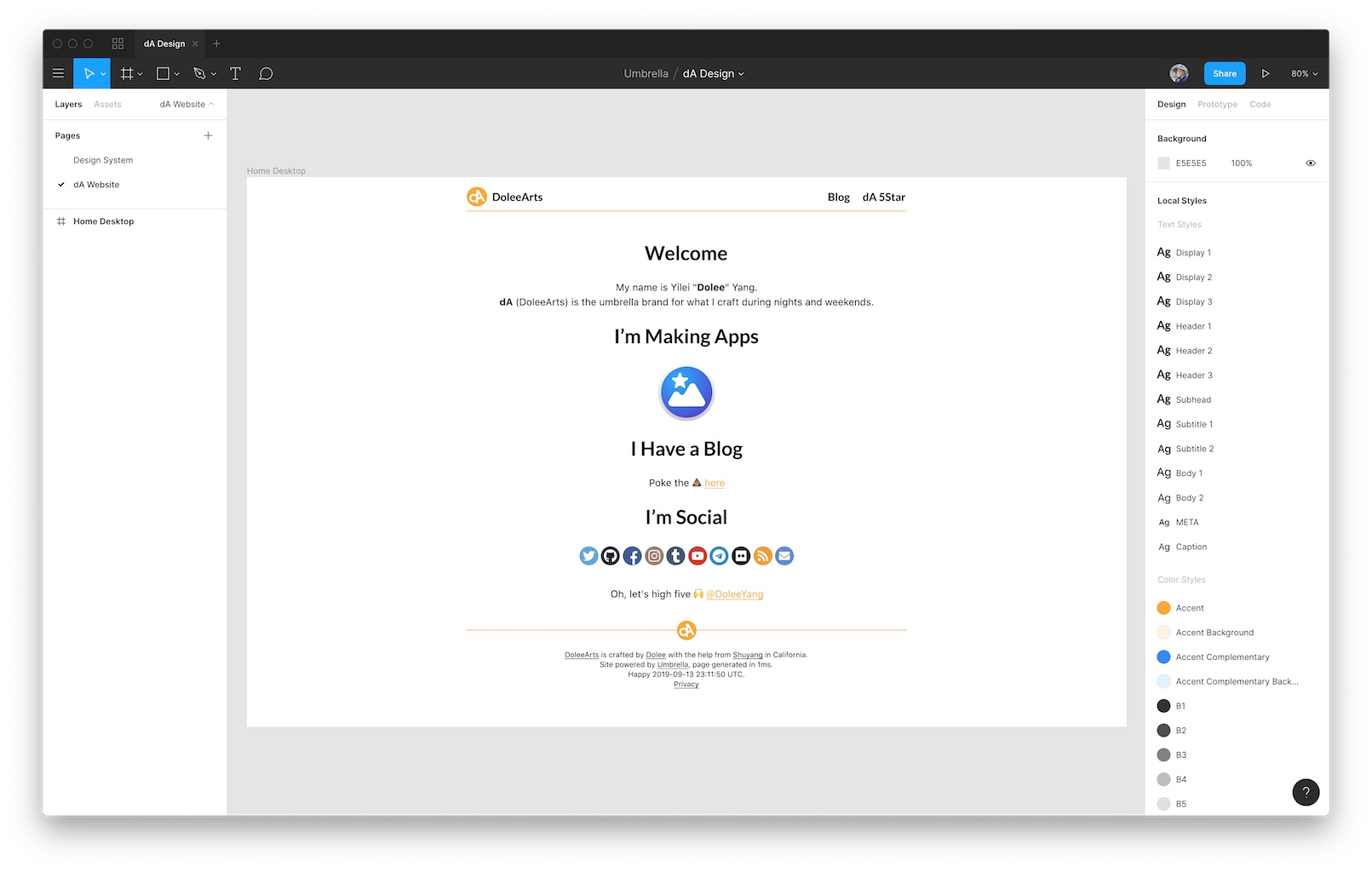
A version of the https://mangoumbrella.com design in Figma.
Figma is really intuitive. When I first saw others' cursors moving in real time, it blew my mind. But for me as a one-person shop, its intuitive interface is the reason I love it. I tried Photoshop, Illustrator, and Sketch. They all failed me. Figma is the first tool I felt home-ish. I still struggle with it, but I do see its potential in my workflow.
I know the design I did today isn't great. It's not even good. It's the worst thing I will probably come up with. And I'm not updating my home page to be exactly what I have designed.
However, the design did improve the website in some areas. And I just incorporated them in the latest build.
Separating code and design does make the product better. I will spend more time on dedicated design sessions.
Accessibility is for Everyone
In this episode of @ParallelPods, @shelly interviewed Sarah Herrlinger of Apple. It’s all great, but this clip in particular reminds me how accessibility is for *everyone*. https://t.co/zi4dqYhWtEhttps://t.co/tEVgtU6ARe pic.twitter.com/rie01d8eJQ
— Casey Liss (@caseyliss) June 12, 2019
Exactly the reaction I had when hearing the iPadOS mouse support feature could be turned on in Accessibility. It’s for everyone, so everyone can turn on.
This also infers that the desire to use a mouse on iPadOS is just like any other need like to use Voice Control. It can't be more normal.
Focused Language Evolutions in Acceleration
It was in either 2010 or 2011, I started following Go, I was attracted to its simplicity, its focus. Not long after, I re-wrote my website in Go from Python, just because of my love.
It was also Go that kick started my interest in the evolution of a language. I started reading all the Go blog posts, watching many Go talks.
This is not by accident. Before that time, the language landscape had actually been relatively quiet. Then Go (2009), Rust (2010), Dart (2011), Swift (2014) appeared in public. Not only they are modern, but they also made language development mainstream again.
Go initially focused on concurrency in a large code base, Rust system programming, Dart first a replacement of Javascript, now the Flutter language, Swift the Apple client applications. Because of their focus and the active evolutions, they are bringing us into a new era of software engineering.
More importantly, the evolutions are accelerating.
2017, Go started the Go 2 evolution process.
2018, Swift for TensorFlow was announced, bringing Dynamic Member Lookup [SE-0195], Dynamic Callable [SE-0216], Static Callable [SE-0253]. Differentiation [SE-XXXX], Dynamic Property Iterations [SE-XXXX].
2019, Dart "UI as Code" happened in 2.3.
2019 WWDC, SwiftUI surprised and excited the Apple developer community, marking the end of the NeXT era. It’s bringing Property Wrappers [SE-0258] and Domain Specific Language [SE-XXXX].
It has never been a greater time for programming languages.
I Grew Up Watching TVs and Movies with Always-on Closed Captioning
Jason Kottke brought up the closed captioning topic today:
A few months ago I noticed that several friends (who speak English and aren’t deaf) routinely watch TV and movies with closed captions and subtitles on. I asked about this on Twitter and the resulting thread was fascinating. Turns out many of you watch TV this way for all kinds of different reasons — to follow complex dialog in foreign or otherwise difficult accents, some folks better retain information while reading, keeping the sound down so as not to wake sleeping children in tight living spaces, and lots of people who aren’t deaf find listening difficult for many reasons (some have trouble listening to dialogue when there’s any sort of non-ambient noise in the background).
When I came to U.S. and started watching TVs and movies, as a non-native speak I was very frustrated that there are no closed captioning. I also didn't know there is the option to turn it on. I wouldn't even think that TV technology actually supports separate closed-captioning data.
You see, I grew up in China. All TVs and movies have always-on closed captioning baked into the stream. There is no option to turn it off.
You ask why that's the case in China?
First, there are many varieties of spoken Chinese with many dialects underneath. Most of TVs and movies are spoken in mandarin. Especially in earlier years, many of the population don't or have difficulties to understand it. But for written Chinese, they are the same, mostly. So closed captioning is understood by more people.
Second, more importantly, homophones. Even though there are tens of thousands of Chinese characters, there are only 1327 pronunciations. That means there are just so many homophones. For common phrases, it not a big problem and we can narrow down further from surrounding context. But for things like names, it's just not possible to know what are the Chinese characters they are speaking. So we rely on close captioning.
Of course, there is also the accessibility reason for people who have hearing loss. But it doesn't explain why closed captioning is the default and there is no option to turn off.
Purl | Pixar SparkShorts
Please also watch the Meet the Filmmakers Behind Purl video. It's only one minute long.
Styrofoam
A great little film by Noah Sheldon.
82% Of the Moon Belongs to the Far Side
Everyone knows that moon has a far side. But you might be surprised that the far side consists of 82% of the surface area. We can only see 18% of the moon from the earth.
Happy New Year

Happy New Year! Hope I can double my portfolio in 2019. Here is a good start - concept for my next game BaBalloons.